Between the handshake and the outcome
Twelve rounds of fifteen minutes, a public laboratory and a panel on the circular economy. One question: what keeps a connection alive once the table is cleared.
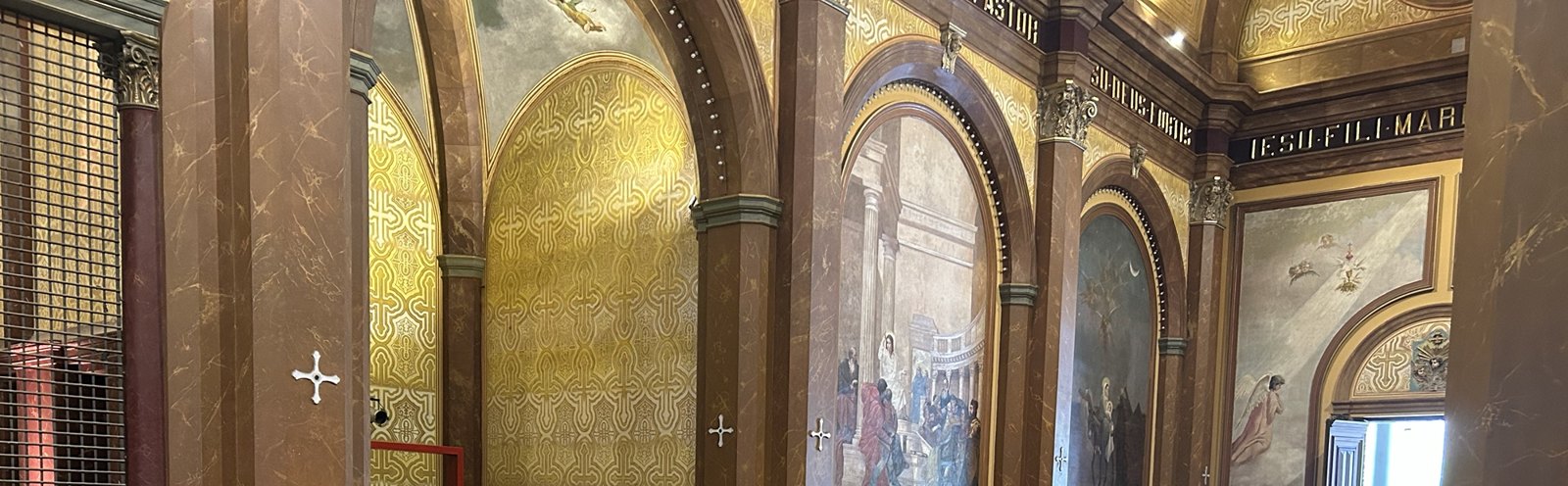
The second day of TCI changed pace. Beneath the murals of the Capilla del Buen Pastor, dozens of numbered tables and, every fifteen minutes, the call to change rounds. Twelve rounds in a single day. The session that opened the morning had a title that read like a warning: From Handshakes to Hard Outcomes.
Fifteen minutes is enough to recognise an affinity. It is not enough to build anything. What comes next depends on what is not on the table, and the organisers knew it: they handed out a memorandum of understanding template so that the day's conversations had a first document to lean on. Over the day we found three answers to that question. A place, a person and an institution.
A place to test. One of our conversations was with CEPROCOR, the public research and development centre of the Province of Córdoba. It is 34 years old, has around 150 researchers and technologists, and works in food, health and the environment with a clear calling: more development than research, always starting from what industry needs and from what is imported today and could be supplied locally. It brings together 17 laboratories and a pharmaceutical pilot plant that meets regulatory standards, which makes something uncommon possible: taking a development from laboratory scale to an intermediate scale before the leap to industry.
The risk of going from the laboratory to a large scale is very large. Having intermediate infrastructure helps reduce that risk.
From the CEPROCOR team, in one of the day's meetings.
In food, the centre works with spray drying and microencapsulation; one development under way is a honey powder that acts as a carrier for proteins and fibre. What those who come from outside value most, they told us, is being able to cover a large part of a development's path in one place. That is why the centre wants to open this infrastructure to more projects, science-based ventures in particular. The question left on the table was, in the end, another kind of match: which technologies entrepreneurs want to develop, and which ones the centre could help them accelerate.
A person to build the path. The conversation touched on two difficulties that are not specific to Córdoba but common to any innovation system. The first is the researcher who wants to start a company and ends up between two worlds, with rules designed for academia and decisions that call for a different training. The second is international funding: calls require partners from other countries who are already working together, and by the time a deadline opens it is too late to get to know each other.
Maria Augusta brought an experience of her own to the table. In Brazil, she coordinated a programme in which science-based startups received business management preparation on one side and laboratory validation of their technologies on the other, ten at a time. What she learned is that neither side can solve it alone. The laboratory provides the proof; someone has to provide the path.
An institution that brings people together. In the afternoon, ECLAC's session on cluster initiatives and the circular economy took the same question to another sector. For a small business, the circular transition runs into barriers no company can solve alone: small volumes, logistics that are expensive for small quantities, and a lack of data and traceability. The panel's answer was collaboration. A cluster makes it possible to gain scale, share infrastructure, such as a collection centre, and build the trust that everything else depends on.
The cases showed it. In Querétaro, the automotive cluster has spent four years acting as a knowledge enabler inside its member companies, building their own capabilities for the circular economy. In Córdoba, the Bioenergy Cluster brings together plants that generate energy from agro-industrial residues and is planning a hybrid community renewable energy park to supply its own companies. Among the examples mentioned, a wooden packaging company stopped selling pallets: it now sells a service.
The level in between. A place, a person, an institution: the three answers occupy the same space, and there is a concept that names it. Systemic competitiveness, formulated in the 1990s at the German Development Institute, holds that competitiveness does not depend only on efficient firms and a stable macroeconomy. Between the two there is a meso level: agencies, technology centres, universities, chambers and clusters that act as bridges. Opening its session, ECLAC noted that its platform already lists some 480 cluster initiatives across the region, and that they do not yet necessarily hold a central place in productive development policy. That is where the work lies: turning the middle from a place people pass through into a part of policy.
What changes for those who design programmes
In your programme, who takes care of what happens after the handshake?
Keep reading: day 3 of the Cuaderno de Córdoba. Or follow FuturAct on LinkedIn.